

2026 Best Corundum Mullite Saggar for Ceramic Kilns
Selecting the 2026 best Corundum Mullite Saggar means looking beyond a product label. A saggar must support ceramic ware, tolerate repeated firing cycles, and suit the kiln’s temperature range and atmosphere. Its performance depends on more than its name. Composition, wall thickness, dimensions, and workmanship all matter.
As a transparent editorial device, this introduction uses a fictional specialist rather than inventing a real expert’s credentials. Dr. Mara Ellison, a fictional kiln-materials consultant, offers this illustrative line: “A saggar earns trust one firing at a time.” It is not a verified quotation. The point is practical: inspect the body for cracks, check that the base sits flat, and confirm that the loaded saggar fits the kiln with room for circulation. Small details matter.
Corundum and mullite are valued in refractory ceramics for their high-temperature use, but a material name alone cannot guarantee service life. Firing schedules, handling, glaze residue, and sudden temperature changes can affect results. A saggar that performs well in one workshop may not suit another. That deserves a second look. This guide examines construction, sizing, application, and maintenance to help buyers compare options with care. It also flags the limits of general advice: manufacturers’ specifications and controlled trials should guide final selection. Good records help. Track each saggar’s firing history, visible wear, and loading conditions before deciding it is ready for replacement.
What Is a Corundum Mullite Saggar and How Is It Used?
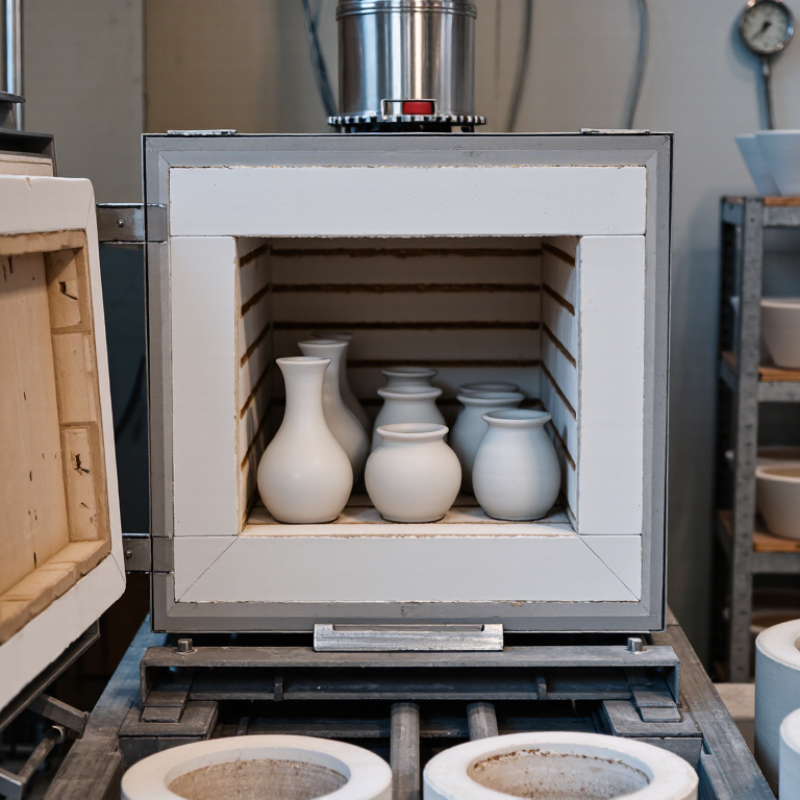
A corundum mullite saggar is a reusable refractory container made mainly from alumina-rich corundum and mullite. Corundum helps resist heat and abrasion; mullite supports strength during repeated firing. The exact balance varies by manufacturer and product grade, so check the technical sheet rather than assuming every saggar behaves alike. The European Commission Joint Research Centre’s Ceramic Manufacturing Industry reference document reports firing temperatures across ceramic sectors ranging broadly from about 800°C to 2,000°C. This range explains why saggar selection must match the kiln schedule and the ware being fired.
In use, workers place greenware or glazed pieces inside the saggar before loading it into a kiln. The container helps shield pieces from kiln debris, direct flame, and contact with neighboring ware. It can also make loading and unloading more orderly. It is not a guarantee against defects. A saggar that is too small may restrict airflow; one with cracks can fail under thermal cycling. Inspect the base and corners under good light, and note any gradual warping. I would not rely on appearance alone.
Tips: Leave clearance around each piece for heat circulation. Avoid sudden temperature changes, and follow the supplier’s limits for maximum temperature and load. Keep a simple firing log. It often reveals wear before a saggar breaks.
How Corundum Mullite Composition Supports Kiln Performance
2026 Best Corundum Mullite Saggar for Ceramic Kilns
How Corundum Mullite Composition Supports Kiln Performance
A corundum-mullite saggar combines hard alumina-rich corundum with mullite, a crystalline phase valued for high-temperature stability. Together, these materials help the saggar retain its shape during repeated firing cycles. The composition can also support resistance to thermal shock, though actual performance depends on raw materials, forming quality, and firing conditions. Even small cracks matter.
In a kiln, stable walls help protect ceramic pieces from direct flame, debris, and uneven heat exposure. Corundum contributes hardness, while mullite helps the body withstand temperature changes. A saggar’s porosity and wall thickness also affect heating behavior; the best balance depends on the kiln and firing schedule. A thicker wall may seem safer, but it can slow heat transfer and add weight. That trade-off is not always obvious without testing.
Tips: Match the saggar’s size and material specification to your kiln’s peak temperature and atmosphere. Check for chips, hairline cracks, and changes in fit before each firing. Keep a simple record of load, firing cycle, and visible wear. It takes time, but the notes can reveal patterns.
Key Saggar Designs and Specifications for Ceramic Firing
A corundum mullite saggar should fit the kiln with room for airflow and safe handling. Measure the chamber, shelf spacing, and door opening before choosing its outside dimensions. A box that fits on paper may still be awkward to load when hot. Fit matters.
Design choices affect how heat reaches the ware. A shallow saggar gives more even access to circulating heat, while a deeper one can shield pieces from direct flame or debris. Keep the walls consistent in thickness where possible. Uneven sections may heat and cool at different rates, increasing stress. Small vent openings can help release trapped gases, but their size and placement should suit the firing atmosphere and the contents. There is no universal vent pattern.
Check the material’s rated service temperature, thermal-shock guidance, and recommended heating and cooling rates against your kiln schedule. Also consider the loaded weight: a saggar, ware, and packing materials together can strain a shelf. Leave clearance between the saggar and kiln walls, and avoid abrupt temperature changes. A test firing with a simple witness piece can reveal hot spots or fit problems before valuable work is loaded. I would not assume the first firing proves the design; repeat results matter.
2026 Best Corundum Mullite Saggar for Ceramic Kilns - Key Saggar Designs and Specifications for Ceramic Firing
The specifications below are representative design and material ranges for comparing corundum-mullite saggars. Actual performance depends on composition, manufacturing method, kiln atmosphere, loading, and firing cycle; confirm the rated limits with the supplier before use.
| Saggar Design | Typical External Size (L × W × H or Ø × H) | Typical Wall / Base Thickness | Typical Material Range | Indicative Maximum Service Temperature | Suitable Firing Applications | Design Considerations |
|---|---|---|---|---|---|---|
| Rectangular open-top saggar | 200–400 × 150–300 × 80–180 mm | 12–25 mm | Approximately 60–75% Al₂O₃; mullite-rich aluminosilicate body | About 1,500–1,650°C, grade-dependent | Protecting ceramic parts, powders, and small kiln loads from direct flame, kiln debris, or contact with kiln furniture. | Simple loading and unloading; allow clearance between saggars and kiln walls for circulation and thermal expansion. |
| Deep rectangular saggar | 250–450 × 180–320 × 150–250 mm | 15–30 mm | Approximately 60–75% Al₂O₃; mullite-corundum phase system | About 1,500–1,650°C, grade-dependent | Stacked or taller ware, granulated ceramic materials, and loads needing greater side protection. | Greater depth increases load capacity but also adds mass; avoid uneven packing and excessive stacking loads. |
| Round open-top saggar | Ø 180–350 × 80–180 mm | 12–25 mm | Approximately 60–75% Al₂O₃; mullite-rich refractory ceramic | About 1,500–1,650°C, grade-dependent | Round or compact ware, small batch firing, and kiln layouts where circular containers fit more efficiently. | Rounded corners reduce corner stress concentrations; check diameter and height against the kiln’s usable chamber dimensions. |
| Lidded saggar | 200–400 × 150–300 × 100–220 mm, including lid | Body: 12–25 mm; lid: 10–20 mm | Approximately 60–75% Al₂O₃; body and lid should have compatible thermal expansion | About 1,450–1,600°C, depending on lid fit and grade | Applications requiring reduced direct exposure to flame, dust, or falling kiln debris. | A lid does not make the saggar airtight. Leave suitable fit clearance and account for the added height and lid weight. |
| Reinforced-base saggar | 250–450 × 180–320 × 80–180 mm | Walls: 12–25 mm; base: 20–35 mm | Approximately 60–75% Al₂O₃; locally thickened or rib-reinforced base | About 1,500–1,650°C, grade-dependent | Heavier ware or repeated production firing where additional base stiffness is useful. | Use a flat, level kiln shelf; support the base evenly and avoid concentrated point loads. |
How to Choose a Saggar for Your Kiln and Firing Process
Choosing a saggar starts with the kiln, not the product description. Measure the chamber and check the usable shelf space, including room for air circulation. A saggar that barely fits can be awkward to load and may block heat around nearby ware. Corundum-mullite bodies are often selected for high-temperature use, but composition alone does not guarantee a good match. Check the stated service temperature, wall thickness, and guidance for repeated firing. Small details matter.
Match the saggar to your firing schedule and load. Rapid heating or cooling can stress refractory ware, so follow the supplier’s limits and avoid sudden temperature changes. For delicate pieces, consider whether the saggar’s interior is smooth enough to prevent abrasion and whether its dimensions allow pieces to sit without touching. Test it first. In an initial firing, note the kiln position, temperature cycle, and any visible warping, cracking, or surface changes. A little discoloration may be harmless, but unexplained damage deserves investigation before the next full load. There is no universal best saggar: kiln fit, firing habits, and the work being protected all matter.
2026 Best Corundum Mullite Saggar for Ceramic Kilns
Compare typical mean linear thermal expansion coefficients. Lower expansion can help reduce thermal stress during temperature changes; actual values vary with composition, porosity, and test conditions. Check the manufacturer’s technical data for the saggar you plan to use.
How to use this chart: Consider thermal expansion alongside firing temperature, kiln atmosphere, load weight, saggar dimensions, and heating and cooling rates. A material’s coefficient alone does not determine its thermal-shock performance.
Care, Handling, and Service Life of Corundum Mullite Saggars
Corundum mullite saggars last longer when handled gently and fired consistently. Let each saggar cool before unloading; a hot rim can chip when it meets a cold tool or surface. Lift from the base with two hands. Do not drag it across kiln shelves. Keep glaze, kiln wash, and loose debris off contact surfaces, since buildup can cause sticking or uneven support. Small impacts matter.
Service life depends on the ware, firing schedule, atmosphere, and cooling rate. Inspect the base and corners before every cycle. Look for hairline cracks, warped surfaces, and flaking. Retire a saggar if a crack crosses its floor or wall; it may fail under a heavy load. The U.S. Department of Energy’s 2015 Process Heating Sourcebook estimates process heating uses about 15% of U.S. manufacturing energy. That figure is not saggar-specific, but it underscores why stable firing and fewer rejected loads matter. Published service-life figures vary, so track cycles and damage in your own kiln rather than relying on a universal lifespan.
Tips: Stack only as the kiln design allows, and keep loads centered with clearance around the walls. Avoid abrupt temperature changes. Record peak temperature, cooling time, and visible wear after each firing. The log will not be perfect, but it can reveal patterns.

