

Top 3D Magnetic Toy Manufacturers in China
China’s 3d Magnetic Toy sector offers buyers a wide range of construction sets, from compact starter kits to larger geometric systems. Yet attractive product photos reveal little about how pieces fit, feel, or hold together during play. A useful review of leading manufacturers should examine magnet consistency, connector design, edge finishing, material quality, and the clarity of assembly instructions. Small details matter. A loose connection can frustrate a child; a smooth, well-matched piece can invite another build.
Dr. Stuart Brown, a psychiatrist and play researcher, has said, “The opposite of play is not work, it’s depression.” His observation concerns play broadly, not magnetic toys specifically, but it highlights why thoughtful design matters. A 3d Magnetic Toy should offer open-ended building while remaining understandable for its intended age group. Buyers can ask manufacturers for material specifications, product samples, and clear quality-control information rather than relying on polished catalog images alone. That takes testing. Not just claims.
This guide introduces three Chinese manufacturers and the factors that can help distinguish their products. It is not a substitute for independent inspection: product ranges, factory practices, and documentation can change. Even a careful comparison may miss something. That is worth remembering when evaluating a supplier. Look closely at the parts, request answers in writing, and compare the finished play experience—not only the price.
Understanding 3D Magnetic Toys and Their Main Product Types
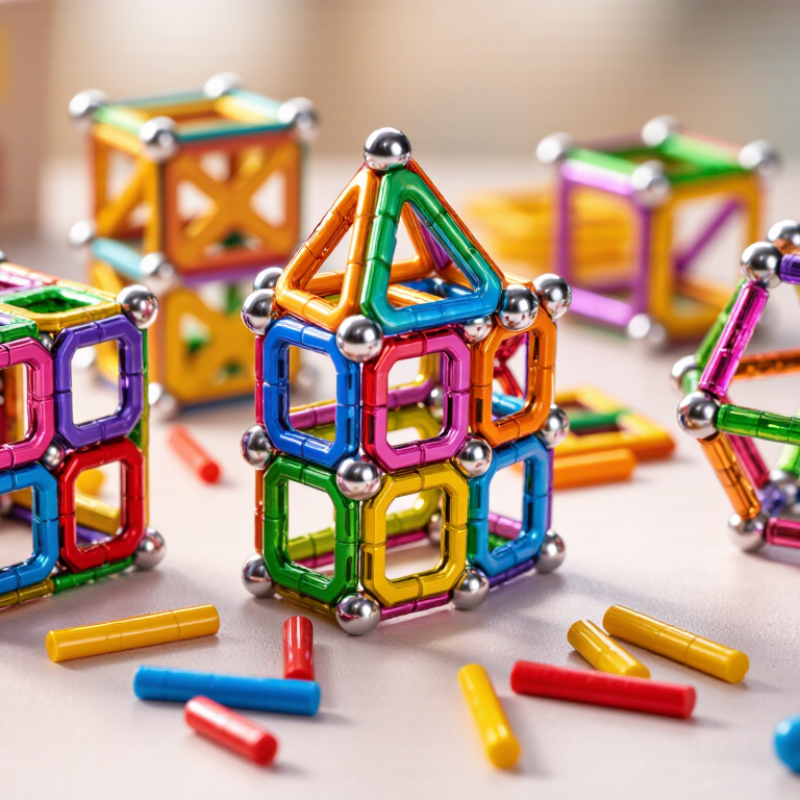
Three-dimensional magnetic toys turn small magnetic parts into structures that stand upright, span gaps, or rotate around joints. Their appeal is hands-on: children can feel a connector snap into place and see a loose cluster become a bridge or a box. The category is not always clearly defined. Some products are magnetic tiles; others use rods, balls, or articulated pieces.
Common types include flat panels for building walls and enclosures, rod-and-sphere sets for wireframe models, and mixed-shape kits for more complex forms.
Some sets emphasize free construction; others guide children toward models. Check how firmly magnets are enclosed, whether pieces connect reliably, and whether the set suits the intended age. Tiny parts can be easy to lose. That matters.
Circana reported that U.S. toy sales grew 6% in 2024 compared with 2023, across the broader toy market. Its figures do not isolate magnetic construction toys, so they should not be treated as proof of demand for this niche. For buyers, the useful distinction is product function: panel systems suit enclosed shapes, while rods and spheres make open frameworks easier. Connectivity can still be frustrating when polarity or connector strength varies. That deserves more attention.
How to Evaluate 3D Magnetic Toy Manufacturers in China
Top 3D Magnetic Toy Manufacturers in China
How to Evaluate 3D Magnetic Toy Manufacturers in China
When comparing Chinese manufacturers, ask for more than polished product photos. Request a factory audit, material declarations, and recent test reports for the exact model you plan to order. Check magnet retention, coating wear, sharp edges, and small-part risks. Ask how each production batch is identified and what happens when a test fails. Small details matter: a loose magnet can be hard to spot during a quick sample review. A sample can look perfect; that proves little about ongoing production.
The U.S. Consumer Product Safety Commission’s Toy-Related Deaths and Injuries report for 2023 estimated 231,700 toy-related emergency-department injuries among children aged 14 and younger. This figure covers toys broadly, not magnetic toys alone, but it underscores why safety checks should be specific and documented. Confirm that testing covers the target market’s applicable requirements, such as ASTM F963 or ISO 8124, and verify reports with the issuing laboratory. Compare the report’s model number, age grading, and tested components against your purchase order. If details do not match, pause.
Tips: Send the same checklist to every supplier. Request dated production photos, traceability records, and a sample from a normal production run—not only a hand-finished prototype. Ask for answers in writing. A vague reply is useful information, too.
Top 3D Magnetic Toy Manufacturers in China: How to Evaluate Them
Suggested evaluation weights for comparing manufacturers. These are procurement priorities, not measured scores or rankings of specific companies.
Prioritize toy-safety documentation, material quality, and magnet retention. Verify applicable market requirements, test reports, and product specifications directly with each supplier.
Profiles of Leading 3D Magnetic Toy Manufacturers in China
Top 3D Magnetic Toy Manufacturers in China
China’s leading 3D magnetic toy manufacturers often differ more in production strengths than in product catalogs.
One profile is the design-led factory, which develops geometric sets, tests how pieces connect, and adjusts shapes after prototype reviews.
Look closely at sample joints: connections should feel steady without making pieces difficult to separate. Small details matter.
A second profile is the high-volume producer, built for repeat orders and consistent molding.
Its strengths may include controlled color matching, tidy edges, and documented checks across production batches. Ask for recent samples and clear inspection records. A polished sample alone cannot show how every batch will look. That gap is worth checking.
A third profile is the flexible supplier, often suited to buyers seeking varied piece counts, packaging options, or modest design changes.
This flexibility can help smaller launches, though lead times and quality may vary with customization. Request a written specification covering dimensions, magnet placement, finish, and packing. No factory is flawless, and honest answers about limitations are useful. Compare evidence, not promises.
Comparing Manufacturers by Products, Quality, and Production Capacity
Top 3D Magnetic Toy Manufacturers in China
Comparing three types of Chinese manufacturers starts with product range. A broad toy producer may offer magnetic tiles, building shapes, and themed sets, making mixed orders easier. A specialist focused on magnetic components may provide more control over magnet placement and fit. A high-volume factory can handle larger runs, but may offer fewer design changes. These are useful distinctions, not a fixed ranking. Ask for current product samples and confirm which parts are made in-house.
Quality depends on details you can inspect. Check whether pieces connect consistently, edges feel smooth, and magnets stay securely enclosed after repeated handling. Request material specifications, inspection records, and relevant toy-safety test documentation for your target market. Then compare production capacity using a realistic order quantity, lead time, and defect-handling process. A large quoted capacity means little if scheduling is vague. Look closely. A polished sample may not match every unit in a bulk order, and that is worth discussing before signing off. Factory visits or independent inspections can add confidence, though they cannot replace clear written specifications.
| Comparison Dimension | Manufacturer 1 | Manufacturer 2 | Manufacturer 3 |
|---|---|---|---|
| Product range | Not verifiable from the information provided; request a current product catalogue. | Not verifiable from the information provided; request a current product catalogue. | Not verifiable from the information provided; request a current product catalogue. |
| Materials and magnet specifications | Not publicly established here. Confirm materials, magnet type, and component specifications with the supplier. | Not publicly established here. Confirm materials, magnet type, and component specifications with the supplier. | Not publicly established here. Confirm materials, magnet type, and component specifications with the supplier. |
| Quality management | Certification status and inspection procedures have not been independently verified. Request current certificates and quality-control records. | Certification status and inspection procedures have not been independently verified. Request current certificates and quality-control records. | Certification status and inspection procedures have not been independently verified. Request current certificates and quality-control records. |
| Toy safety testing | Test results are not available here. Verify the applicable destination-market requirements and request relevant test reports for the specific product. | Test results are not available here. Verify the applicable destination-market requirements and request relevant test reports for the specific product. | Test results are not available here. Verify the applicable destination-market requirements and request relevant test reports for the specific product. |
| Production capacity | Not disclosed or verified. Request documented monthly capacity for the selected product and order quantity. | Not disclosed or verified. Request documented monthly capacity for the selected product and order quantity. | Not disclosed or verified. Request documented monthly capacity for the selected product and order quantity. |
| Lead time and minimum order quantity | Not verified; request a written quotation specifying MOQ, sampling time, and production lead time. | Not verified; request a written quotation specifying MOQ, sampling time, and production lead time. | Not verified; request a written quotation specifying MOQ, sampling time, and production lead time. |
| Comparison status | Supplier-specific information was not supplied, so a factual ranking cannot be established. | Supplier-specific information was not supplied, so a factual ranking cannot be established. | Supplier-specific information was not supplied, so a factual ranking cannot be established. |
Key Considerations When Sourcing 3D Magnetic Toys in China
When comparing 3D magnetic toy manufacturers in China, look beyond smooth sample photos. Ask how magnets are fixed inside each piece, and request retention test results from production batches. Check coating durability, sharp edges, small-part risks, and whether the assembled toy matches its age grading. Test the real thing. A sample that survives gentle handling may fail after repeated drops, so inspect pieces after use-like stress. Request material declarations, batch traceability, and test reports relevant to your destination market.
Factory capacity matters, but so does what happens after inspection. The OECD’s Global Plastics Outlook (2022) estimates that only 9% of plastic waste was recycled globally in 2019; ask suppliers to specify packaging materials and avoid unnecessary mixed-material inserts. UNCTAD’s Review of Maritime Transport 2023 reports that over 80% of world trade by volume travels by sea, making carton strength and moisture protection practical sourcing concerns. Ask for carton dimensions, loading photos, and a realistic production schedule before placing an order. Small details matter. I would also compare inspection findings across more than one batch: a tidy factory visit is reassuring, but it is not proof of consistent quality.

