

What Are the Top 10 Types of Decorative Boards?
Decorative Boards shape the look and everyday feel of kitchens, wardrobes, offices, and retail interiors. Their differences are not merely cosmetic. A board’s core, surface layer, edge treatment, and finish influence its weight, cleanability, repair options, and suitability for a particular room. Small details matter: a matte fingerprint-resistant panel can feel calmer than glossy acrylic, while a veneer’s grain may vary from one sheet to another.
Architect and mass-timber specialist Michael Green has said, “Wood is the only major building material that grows naturally.” That perspective is useful when comparing wood-based boards, though it does not describe every decorative surface. This guide examines ten common types, including melamine-faced board, veneer, high-pressure laminate, acrylic, PET, PVC, lacquered panels, plywood, MDF, and compact laminate. Some categories overlap. That can be confusing.
For a fair comparison, look beyond product names. Check the substrate, surface specification, edge finish, and care guidance; request a sample under your actual lighting. A warm oak pattern may look different beside cool countertops. Kitchen splash zones also place different demands on panels than bedroom wardrobes do. No single board is best everywhere. The outline that follows explains typical features, practical strengths, and limitations, while noting that product quality varies by manufacturer. Real samples help. Product labels alone rarely tell the whole story.
Veneer and Plywood Decorative Boards
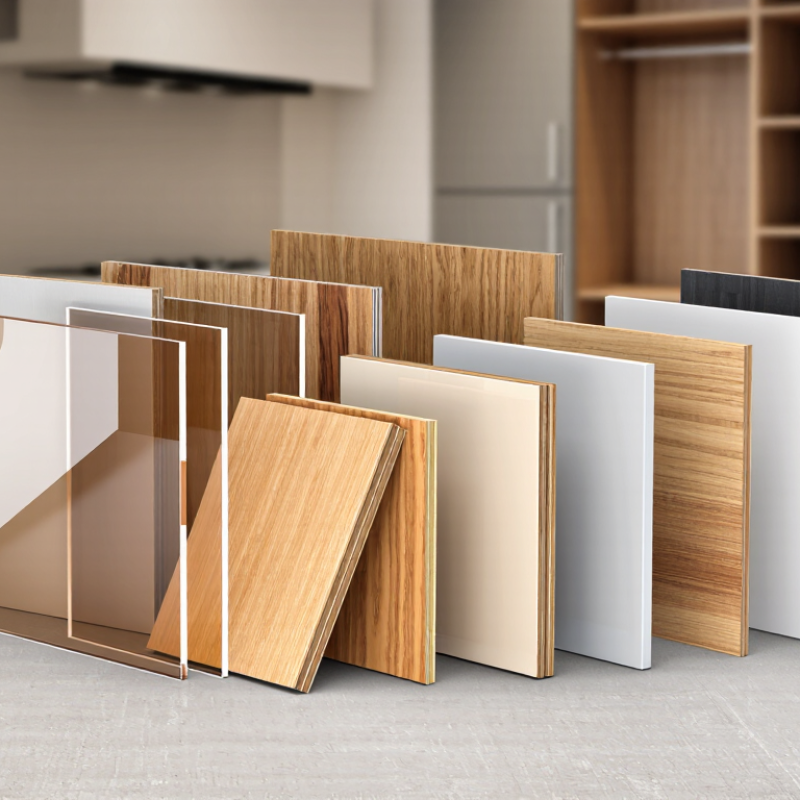
Veneer and plywood decorative boards offer different ways to bring wood character into an interior. A veneer board has a thin layer of real wood bonded to a core, often plywood or fiberboard. Its grain adds warmth without requiring a thick slab of expensive timber. Plywood decorative boards are made from cross-laminated wood layers, often with a finished face veneer. The layered core can provide useful strength and dimensional stability.
Looks can mislead. A smooth surface does not automatically mean a board will suit every room. Check the face for consistent grain, patches, and color changes under natural light. For a kitchen cabinet door, also consider edge treatment and the finish’s resistance to frequent wiping. In a dry living room, appearance may matter more than moisture resistance. Still, this is not a perfect rule; ventilation, installation, and upkeep all affect performance. Ask about the core, veneer thickness, and recommended cleaning method before choosing. Small samples help, but they may not show how grain patterns repeat across a full wall or cabinet run.
MDF, HDF, and Particleboard Decorative Boards
Decorative board choices often begin with the surface, but the core affects weight, screw holding, and moisture tolerance. MDF uses fine wood fibers pressed with resin, creating a smooth, consistent face for paint or decorative films. It suits routed cabinet fronts and shelves where a clean finish matters. HDF is denser and harder, making it useful for thin panels, door skins, and surfaces that see frequent contact. It is heavier, though. Particleboard uses larger wood particles bonded into a panel. It is often an economical choice for flat-pack furniture and broad, well-supported shelves. These boards are not interchangeable.
Think about the room and the construction, not just the finish. MDF can be easier to machine cleanly, while HDF offers greater density in a thinner panel. Particleboard may sag if a long shelf lacks support, and exposed edges can chip during handling. Moisture-resistant grades can help in humid areas, but they are not waterproof. The difference is easy to miss on a small sample, so check the panel specification before ordering.
Tips: Check panel thickness, edge quality, and the recommended fasteners. For shelves, measure the span and add support where needed. Seal cut edges near occasional splashes. Small details matter.
Blockboard and Melamine-Faced Decorative Boards
Blockboard and melamine-faced decorative boards solve different design problems. Blockboard has a core of narrow solid-wood strips sandwiched between veneer layers. This construction makes it useful for doors, partitions, and shelves where a relatively light, rigid panel is wanted. But rigidity is not unlimited. Long shelves can still sag, so check panel thickness, support spacing, and the supplier’s load guidance before specifying it.
Melamine-faced boards usually use particleboard or MDF beneath decorative paper bonded with resin and heat. They offer a ready-to-use surface for cabinets, desks, and wardrobes, often with less finishing work. The European Panel Federation’s 2023 annual report puts European wood-based-panel production at roughly 58 million cubic metres in 2022, showing the scale of this material category—not the market share of either board type. A useful distinction. Melamine faces can resist everyday stains and abrasion, but performance varies by grade; exposed edges remain vulnerable to moisture and impact. Edges matter. I would compare the technical datasheet and inspect a cut edge, rather than choose by surface appearance alone. One detail is easy to overlook: a convincing wood pattern does not make the core solid timber.
What Are the Top 10 Types of Decorative Boards?
Typical commercial thickness ranges for popular decorative board types
How to read this chart: Each bar shows an indicative thickness range in millimeters, not a popularity ranking. Actual product specifications and available thicknesses vary by manufacturer and market.
High-Pressure Laminate and PVC-Faced Decorative Boards
High-pressure laminate (HPL) and PVC-faced boards offer two distinct ways to add a durable, decorative surface. HPL is a separate sheet bonded to a substrate, often particleboard or fiberboard. It suits busy counters, cabinet doors, and work surfaces where frequent wiping is expected.
Grand View Research estimated the global decorative laminates market at about US$7.6 billion in 2023, with a projected 5.8% annual growth rate from 2024 to 2030. This signals broad demand, but market growth alone does not prove a panel will perform well in a specific room.
PVC-faced boards use a thin polymer film over a core, creating smooth colors or wood-like textures without a separate laminate sheet. They can work well on wardrobe doors and interior cabinetry, but heat, sharp edges, and poor sealing can shorten their service life. Check the edge finish and substrate, not just the face.
ISO 4586 sets test methods and requirements for decorative high-pressure laminates, including resistance to wear and staining; ask suppliers for relevant test documentation.
A glossy sample can look convincing. It may still show fingerprints or scratches more clearly in daily use. Compare samples under the room’s actual lighting, and remember that installation quality matters as much as the surface.
Acrylic-Faced Decorative Boards
Acrylic-faced decorative boards bring a smooth, glass-like finish to cabinets, wardrobes, and wall panels. A clear acrylic layer sits over a decorative surface and a stable board core. The result can reflect light across a room, making compact spaces feel brighter. Color and sheen vary, from soft neutrals to vivid tones. The surface is also easy to wipe clean after fingerprints or light splashes.
The finish has limits. Scratches can show, especially on darker, glossy colors, and damaged edges may be difficult to repair invisibly. Check the board’s core, thickness, and edge treatment before choosing it for a project. In kitchens or bathrooms, ask for product-specific moisture guidance; “easy to clean” does not mean waterproof. Samples help, but view them under your own lighting. I have found that a small sample can look more dramatic than a full cabinet door, so consider that difference.
Tips: Use a soft microfiber cloth and mild soap. Avoid abrasive pads. Protect exposed edges from standing water, and inspect seams near sinks. For large panels, plan the layout carefully; reflections can make uneven joins more noticeable.
What Are the Top 10 Types of Decorative Boards? - Acrylic-Faced Decorative Boards
| Decorative Board Type | Typical Substrate | Decorative Surface | Key Characteristics | Common Applications |
|---|---|---|---|---|
| Melamine-Faced Particleboard | Particleboard | Decorative paper impregnated with melamine resin and pressed onto the panel | Available in many colors and printed patterns; the factory-applied surface is easy to clean. Edges usually need separate edging, and the panel should be protected from prolonged moisture. | Cabinet carcasses, shelves, wardrobes, and budget-conscious furniture |
| Melamine-Faced MDF | Medium-density fiberboard (MDF) | Melamine-impregnated decorative paper | Offers a smooth, uniform face that works well for detailed machining and clean-looking furniture components. Moisture performance depends on the MDF grade and panel construction. | Cabinet doors, wardrobe panels, shelving, and interior furniture |
| High-Pressure Laminate (HPL) Board | Particleboard, MDF, or plywood with a bonded laminate sheet | Decorative laminate made by pressing resin-treated paper layers under heat and pressure | Provides a durable, wear-resistant decorative face. Surface performance varies by laminate grade; exposed edges and joints require appropriate detailing. | Worktops, counters, desks, wall panels, and commercial interiors |
| Natural Veneer Board | MDF, particleboard, or plywood | Thin sheets of real wood veneer, typically finished with a clear coating | Shows natural grain and variation, so color and pattern can differ between sheets. The veneer is thin and may need careful protection from scratches and moisture. | Furniture fronts, wall panels, doors, and feature interiors |
| Acrylic-Faced Decorative Board | Usually MDF or particleboard | A decorative acrylic sheet or acrylic-based surface layer bonded to the panel | Often selected for its smooth, high-gloss appearance and reflective finish; matte options are also available. Scratch resistance, repairability, and UV stability vary by product construction. | Kitchen and bathroom cabinetry, wardrobe doors, display units, and modern furniture |
| PET-Faced Board | MDF or particleboard | Decorative polyethylene terephthalate (PET) film bonded to the panel | Available in gloss and matte finishes, with a consistent manufactured appearance. Performance depends on film thickness, bonding quality, and edge treatment. | Cabinet doors, drawer fronts, wardrobes, and interior furniture |
| PVC-Laminated Board | MDF or particleboard | Polyvinyl chloride (PVC) film applied to one or more panel faces | Can cover shaped profiles and provide a continuous decorative surface. Heat resistance and long-term adhesion depend on the film, adhesive, and manufacturing process. | Profiled cabinet doors, furniture fronts, and decorative interior components |
| UV-Coated Board | Commonly MDF | Decorative coating cured using ultraviolet light | Can produce a smooth, glossy or matte finish. The coating is applied to the panel surface; edges may have a different finish and need separate protection. | Cabinet fronts, wall panels, shelving, and furniture components |
| Decorative Plywood | Cross-laminated wood veneer plies | Selected face veneer, printed overlay, or decorative surface coating | Its layered construction provides dimensional stability and useful strength for many panel applications. Appearance and surface quality depend on the face veneer or overlay grade. | Furniture, cabinetry, wall lining, partitions, and interior joinery |
| Compact Laminate Board | Multiple resin-impregnated paper layers compressed into a solid laminate panel | Decorative laminate faces formed as part of the compact panel | Dense, self-supporting construction with decorative faces on both sides; commonly chosen where a robust panel is needed. Suitability for wet areas depends on the specification and installation details. | Partitions, restroom cubicles, laboratory furniture, lockers, and work surfaces |
Note: These are common decorative panel categories, not a universal performance ranking. Actual durability, moisture resistance, fire performance, and maintenance requirements depend on the specific panel grade, surface system, edge treatment, and installation conditions.

